Account Engine Overview
Overview
The Accounting Engine is a service which enables standardized accounting for similar products/transactions/contracts from multiple source systems. It ingests financial information from a variety of front office systems and produces journal quality accounting entries, i.e. patterns of debits and credits for consumption by downstream systems, typically subledgers. It validates and enriches this information and then applies accounting logic to these records to produce patterns of debits and credits in accordance with your requirements. It assigns these debit record (DR) and credit record (CR) to appropriate Accounts. It allows you to use a single input record to generate multiple DRs and CRs, for multiple of GAAPs/reporting requirements based on your configurations. These DR and CR are then grouped into Journals.
The Accounting Engine converts real-world or life-cycle events (business events) into the required financial representations of these events (journals) so that they can be accounted for correctly based on flexible and configurable accounting rules.
Why Do You Need an Accounting Engine?
- It ensures quality of data, by filling in the gaps in inbound data
- Allows inbound financial information to be enriched to become rich enough for the required accounting entries to be generated
- Increases process efficiency by:
- Providing a centralized repository of accounting logic
- Allowing for common accounting to be applied in a consistent manner across multiple inbound sources
- Reducing the overall maintenance effort (i.e. A single change affects multiple data streams)
- Increases audit and control capabilities:
- Time bound rules
- Audited change history for rules
- Approval processes for rule changes
The Accounting Engine prevents issues with:
- Duplication of data
- Consistency of accounting
- Reconciliation
- Audit and traceability
- Maintenance
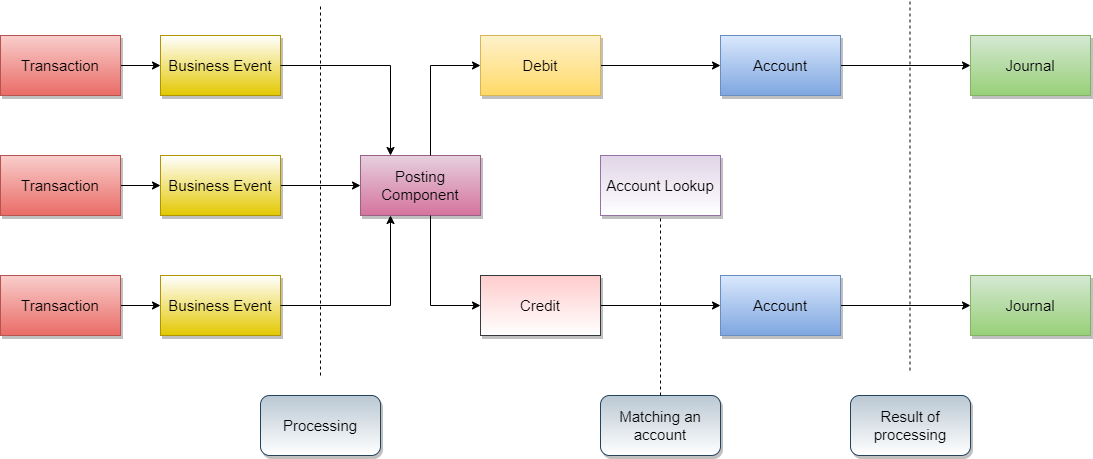
What Does the Accounting Engine Do?
- The Accounting Engine receives real world or life-cycle events in the form of Business Events.
- These raw Business Events are mapped to Posting Components, which then create debit and credit groups which are called Accounting Entries
- The Accounting Entries are then enriched with the Accounts
- Once the enrichment is complete, a complete (i.e. enriched) Journal is validated and posted to the target system (GL or SLR)
Definitions
Business Event
A representation of a real world transaction/life-cycle event for which accounting is required.
Posting Component
A configuration of DR/CR patterns which can be used to create Accounting Entries.
Account
An Account to which the transaction will be assigned.
Journal Line
Accounting record which comprises a Journal.
Journal
An accounting entry enriched with all the required fields/details so that it can be consumed by a target system (subledger or GL). This does not currently include any currency amounts other than the transaction currency.

